
Water leak detection equipment helps engineers investigate concealed pipe leaks, unexplained water loss and moisture damage without immediately breaking through walls or floors. Different instruments measure different physical conditions, including sound, temperature, moisture, pressure and escaping tracer gas.
At MML Plumbing Ltd, we use a combination of diagnostic equipment when investigating water leaks in North London properties. Our equipment includes acoustic listening devices, thermal imaging cameras, hydrogen tracer gas detectors, moisture meters, pressure-testing instruments, borescopes and specialist equipment for checking water movement and pipework.
No single water leak detector can reliably identify every type of leak. A thermal camera cannot see through walls, a moisture meter cannot prove that a pipe is leaking, and an acoustic detector may struggle to identify a very small leak that produces little sound.
The purpose of professional leak detection equipment is to collect evidence, test possible explanations and narrow down the source of water escape before recommending access or repairs.
This guide explains the equipment we use, how each method works, where it performs best and why combining different testing techniques is often necessary.
What Equipment Do Professional Leak Detection Engineers Use?
Professional water leak detection equipment generally falls into several categories, depending on the physical evidence being investigated.
| Equipment | What it measures or detects | Typical application | Main limitation |
|---|---|---|---|
| Acoustic leak detector | Sound and vibration generated by escaping water | Pressurised pipes beneath floors or underground | Small, low-pressure or intermittent leaks may be difficult to hear |
| Thermal imaging camera | Infrared radiation used to calculate apparent surface temperature | Heating pipes, hot-water leaks and moisture investigations | Cannot see directly through walls or identify water conclusively |
| Hydrogen tracer gas detector | Tracer gas escaping from a tested pipe system | Concealed pressurised pipework and buried supplies | Gas movement and surface conditions can affect localisation |
| Moisture meter | Electrical properties associated with material moisture | Mapping dampness in walls, ceilings and floors | Does not identify the source of moisture |
| Pressure-testing equipment | Pressure changes within an isolated system | Establishing whether a pipe circuit is losing pressure | Pressure loss alone does not locate the defect |
| Borescope camera | Visible conditions inside an accessible cavity | Inspecting behind panels, beneath floors and inside voids | Only shows areas within the camera's field of view |
| Water meter and flow checks | Water consumption or flow when outlets should be closed | Investigating suspected supply-pipe leaks | Small or intermittent losses may not register clearly |
| Dye-testing equipment | Visible movement of coloured test water | Showers, baths, seals and drainage connections | Requires suitable test conditions and observation points |
| Pipe-location equipment | Pipe position or route, depending on the technology | Mapping accessible or buried pipe routes | Identifies the route, not necessarily the leak |
The equipment is selected according to the symptoms and the type of plumbing system being investigated.
For example, a central heating circuit that repeatedly loses pressure requires a different testing approach from a shower that leaks into the ceiling below only when someone uses it.

1. Acoustic Leak Detection Equipment
Acoustic leak detection equipment is designed to identify sound and vibration produced when water escapes from a pressurised pipe.
When water passes through a small opening in a pipe wall or fitting, the pressure difference can generate turbulence and vibration. Depending on the pipe material, pressure and surrounding structure, that sound may travel along the pipe or through adjacent materials.
Professional listening equipment amplifies and filters these signals so an engineer can compare readings at different locations.
Ground Microphones and Electronic Listening Devices
Ground microphones are commonly used when investigating pressurised pipes beneath concrete floors, paving or other solid surfaces.
The engineer places the sensor against the surface and listens for sound associated with escaping water.
Repeated measurements help establish where the signal is strongest and whether it is consistent with the suspected pipe route.
Electronic listening devices can also be used on accessible pipework, valves and fittings to investigate vibration transmitted through the plumbing system.
Different instruments are suitable for different testing conditions. Our guide explains what equipment is used for acoustic leak detection.
How Acoustic Equipment Helps Locate a Leak
An engineer first establishes which pipe system is suspected of leaking.
Listening measurements are then taken at suitable locations, with the results compared against the expected pipe route and background noise.
A stronger sound may indicate proximity to the leak, but the loudest reading does not automatically identify its exact position.
Sound can travel along metal pipes and through concrete, sometimes producing a stronger signal away from the actual defect. This is particularly important when assessing whether acoustic sound detection can accurately locate underground water leaks.
Limitations of Acoustic Leak Detection
Acoustic equipment generally performs best when escaping water produces a detectable signal.
Detection can be more difficult when:
- The pressure difference across the leak is small.
- The leak is intermittent.
- The pipe is plastic or surrounded by sound-absorbing materials.
- Machinery, traffic or running appliances produce background noise.
- The leak produces insufficient turbulence.
Acoustic testing is therefore often combined with pressure testing or another independent diagnostic method.
Further reading: Acoustic Leak Detection Services.

2. Thermal Imaging Cameras
Thermal imaging cameras measure infrared radiation emitted from surfaces and convert it into an image representing apparent surface temperatures.
They are useful for investigating temperature patterns associated with concealed hot-water pipes, central heating circuits and areas affected by moisture.
However, thermal cameras do not detect water directly and cannot see through walls or concrete.
Instead, they reveal surface-temperature differences that may help an engineer identify an area requiring further investigation.
How Thermal Imaging Works
A thermal imaging camera records infrared radiation from a surface.
The camera uses this information, together with settings such as emissivity and reflected temperature, to estimate apparent surface temperature.
Different temperatures are displayed using a colour palette, making variations easier to recognise.
For example, a hot-water pipe beneath a floor may create a warmer surface pattern when hot water passes through it.
If water escapes from the pipe, heat transfer into surrounding materials may produce an unusual temperature distribution.
However, the visible pattern can also be affected by insulation, building materials, air movement and other heat sources.
Detecting Hot-Water and Heating Pipe Leaks
Thermal imaging is particularly useful when investigating suspected leaks from hot-water or central heating pipework.
An engineer may observe the system during operation to identify expected pipe routes and unusual heat patterns.
A warm area extending beyond the expected pipe position can justify additional testing, but it is not conclusive evidence of a leak.
Temperature patterns must be interpreted alongside the plumbing layout, pressure-test results and other observations. This is particularly important when investigating whether thermal imaging can identify the source of boiler pressure loss.
Can Thermal Imaging Detect Cold-Water Leaks?
Thermal imaging can sometimes identify temperature differences associated with cold-water leaks.
For example, cooler water entering a warmer building material may create a detectable surface pattern.
Evaporation from damp materials can also affect surface temperature.
Nevertheless, these effects are not guaranteed.
A cold-water leak may produce no useful thermal contrast, particularly when the water and surrounding structure are at similar temperatures.
Limitations of Thermal Imaging
Thermal images can be misleading when interpreted without supporting evidence.
Common sources of false indications include:
- Thermal bridging.
- Insulation differences.
- Air movement.
- Reflections from shiny surfaces.
- Sunlight and external temperature changes.
- Normal heating pipe routes.
- Dampness unrelated to plumbing leaks.
A thermal image should therefore be treated as diagnostic evidence rather than proof of a particular leak.
Further reading: Thermal Imaging Leak Detection in London.
3. Hydrogen Tracer Gas Leak Detection Equipment
Hydrogen tracer gas detection is a specialist method used to investigate leaks in suitable pipe systems.
At MML Plumbing, hydrogen tracer gas testing forms part of our non-invasive diagnostic work, particularly where conventional inspection and acoustic testing cannot establish the location of a concealed leak.
The method involves introducing a controlled tracer gas mixture into an isolated system and using a sensitive detector to investigate where the gas may be escaping.
What Is Hydrogen Tracer Gas?
A commonly used tracer gas mixture contains approximately 5% hydrogen and 95% nitrogen.
Hydrogen is used because it is a small, highly mobile molecule that can pass through openings in defective pipework.
The nitrogen acts as the carrier gas.
The mixture is selected for specialist leak testing, but the procedure still requires suitable equipment, pressure control and competent handling.
For a more detailed explanation, see what hydrogen leak detection is and how it works.
How Hydrogen Tracer Gas Testing Works
The engineer first establishes which pipe circuit requires testing and whether it can be safely isolated.
The system is prepared according to the test procedure, which may involve removing water from the relevant section before introducing the tracer gas.
The gas is introduced under controlled conditions appropriate to the pipework.
A hydrogen-sensitive detector is then used to take readings at selected locations, including along suspected pipe routes, around joints and near possible gas escape points.
Where tracer gas passes through a defect, it may migrate through surrounding materials and become detectable at the surface.
Repeated measurements help determine whether a reading is consistent, localised and associated with the tested system.
Hydrogen Detection Instruments
The original MML Plumbing article identifies the VARIOTEC 460 as an example of the tracer gas detection equipment used.
This type of specialist instrument is designed to detect hydrogen tracer gas concentrations during leak investigations.
Its usefulness depends not simply on sensitivity but also on correct system preparation, sampling technique, environmental conditions and interpretation.
A positive hydrogen reading must be evaluated in context.
Can Hydrogen Tracer Gas Find Leaks Beneath Concrete?
Hydrogen tracer gas can be useful when investigating concealed pipework beneath concrete or other floor structures.
Gas escaping from a pipe may travel through joints, cracks, service penetrations or porous materials.
However, the point where gas becomes detectable at the surface may not be directly above the pipe defect.
Gas movement can be influenced by the floor construction, insulation, cavities and surrounding materials.
This is why readings should be repeated and compared with the pipe route and other test results before recommending excavation.
Limitations of Hydrogen Tracer Gas Testing
Hydrogen testing is not suitable for every situation.
Its effectiveness depends on factors including:
- Whether the relevant pipe circuit can be isolated.
- Whether the system can be prepared safely for testing.
- The size and behaviour of the leak.
- The surrounding building materials.
- The availability of suitable sampling points.
- Gas migration through cavities or alternative pathways.
A negative reading does not necessarily prove that no leak exists.
Likewise, a positive reading does not automatically identify the precise location where the pipe should be opened.
Further reading: Hydrogen Leak Detection in London.


4. Moisture Meters and Moisture Mapping Equipment
Moisture meters are used to investigate dampness in walls, ceilings, floors and other building materials.
Unlike acoustic or tracer gas equipment, moisture meters do not directly detect water escaping from a pipe.
Instead, they help establish where moisture is present, how it is distributed and whether its pattern is consistent with the suspected source.
Pin-Type Moisture Meters
Pin-type meters use electrodes inserted into a suitable material to measure electrical resistance.
In timber, resistance-based measurements can provide an estimate of moisture content when the instrument is correctly calibrated and used.
In plaster, masonry and other building materials, readings are often comparative rather than an accurate percentage of water content.
Salts, metallic components and differences in material composition can influence the results.
Pinless Moisture Meters
Pinless meters use electromagnetic sensing to investigate moisture-related changes beneath a surface without inserting electrodes.
These instruments are useful when examining finished walls, ceilings and floors where unnecessary surface damage should be avoided.
However, their readings can be influenced by metalwork, foil-backed insulation, material density and construction differences.
How We Use Moisture Mapping
At MML Plumbing, moisture mapping helps us understand the distribution of water damage.
For example, when a downstairs ceiling becomes wet after someone uses the upstairs bathroom, we may compare readings across the affected ceiling, adjacent walls and surrounding areas.
The resulting pattern helps establish where water has accumulated.
It does not necessarily identify where the water originally escaped.
Water can travel along timber, plasterboard, insulation and other materials before becoming visible.
We therefore combine moisture readings with plumbing inspections and other appropriate tests.
Further reading: Moisture Leak Detection in London.
5. Water Pressure Testing Equipment
Pressure testing is one of the most important diagnostic procedures used when investigating suspected leaks in pressurised plumbing systems.
It helps determine whether an isolated section of pipework maintains pressure under controlled conditions.
Unlike thermal imaging or moisture mapping, pressure testing directly evaluates the pressure-retaining behaviour of the tested system.
However, it does not establish the physical location of a leak.
How a Plumbing Pressure Test Works
The engineer identifies the system requiring investigation and isolates the relevant pipework where possible.
A suitable pressure gauge or testing instrument is connected.
The system is then monitored under conditions appropriate to its design and operating limitations.
The engineer records the starting pressure, test duration and any changes observed.
Depending on the installation, testing may involve a water-filled system or another approved procedure.
Temperature changes, trapped air, valve behaviour and other factors can influence pressure readings.
Consequently, a pressure reduction must be interpreted carefully rather than automatically attributed to a leaking pipe.
Testing Central Heating Pipework
Pressure testing is particularly useful when investigating sealed central heating systems that repeatedly lose pressure.
An engineer may need to distinguish between water escaping from the heating pipework and other possible causes, such as a defective expansion vessel, pressure relief valve or leaking component.
Where suitable isolation is possible, individual sections can be assessed separately.
A stable pressure test provides evidence about the system’s behaviour during the test period, but it cannot guarantee that an intermittent fault will never occur.
Why Test Duration Matters
A short pressure test may not reveal a very small leak.
Longer observation periods can provide additional evidence, although the appropriate duration depends on the system and investigation.
At MML Plumbing, we record relevant pressure readings and test durations in our technical reports.
These measurements are considered alongside the other evidence collected.

6. Borescope and Endoscope Inspection Cameras
Borescopes are small inspection cameras used to examine concealed spaces that cannot be viewed directly.
They are particularly useful when investigating plumbing behind bathroom panels, beneath floors or inside accessible wall cavities.
A flexible camera probe is inserted through an existing opening or a suitably positioned access point.
The engineer can then inspect the surrounding area using the camera’s lighting and display.
What Can a Borescope Reveal?
A borescope may identify visible water droplets, staining, corrosion, damaged fittings or water tracking through a concealed space.
It can also help establish whether a pipe connection is accessible without removing a larger section of wall or flooring.
For example, when investigating a concealed toilet installation, a camera may help inspect the area around the cistern, supply connection or waste fitting.
Can a Borescope See Inside Water Pipes?
Not automatically.
A standard inspection borescope is primarily used to examine accessible cavities and exposed surfaces.
Inspecting the internal condition of a pipe requires a camera system suitable for the pipe diameter, access arrangement and operating conditions.
It is therefore inaccurate to assume that every borescope can travel through domestic water pipes and identify internal defects.
Limitations of Borescope Inspections
A borescope only shows what lies within its field of view.
Insulation, structural elements, pipe positioning and restricted access can prevent the camera from reaching the suspected area.
An absence of visible water does not prove that a concealed leak is absent.
Further reading: Borescopic Leak Detection Services.
7. Dye Testing Equipment for Showers, Baths and Waste Connections
Not every water leak originates from a pressurised pipe.
Many bathroom leaks occur only when a shower, bath, toilet or waste connection is used.
In these situations, acoustic equipment and pressure testing may not establish the cause.
Dye testing can help investigate how water moves through a bathroom installation.
How Dye Testing Works
A suitable water-soluble tracing dye is introduced into a controlled test.
The engineer observes whether coloured water appears at a suspected escape point or in an accessible area below.
Different components may need to be tested separately.
For example, a shower investigation may involve checking the waste connection, shower tray perimeter, screen seals and surrounding tiled surfaces.
Testing Shower Waterproofing
A shower can leak even when its supply and waste pipes are sound.
Water may pass through failed silicone, defective joints or inadequately waterproofed surfaces.
At MML Plumbing, we investigate these problems by examining the relevant seals, fittings and drainage components.
Where appropriate, controlled water application and dye testing help establish whether the water escape is associated with a particular area.
A successful test must be interpreted alongside the construction of the shower.
Grout and tiles alone should not be relied upon as the primary waterproofing system in a wet area.
Limitations of Dye Testing
Dye testing requires a suitable route for the test water and an observable result.
Water may accumulate within a concealed void without becoming visible during the test period.
A negative test therefore does not necessarily exclude every possible defect.
Where several potential sources exist, separate tests are important to avoid confusing the results.
8. Water Meters and Flow Monitoring
Water meters can provide useful evidence when investigating suspected leaks on domestic water supply systems.
A simple check involves observing whether the meter registers consumption when all known outlets and water-using appliances are switched off.
Unexpected meter movement may indicate that water is passing through the supply system.
However, the interpretation depends on the meter arrangement, connected appliances and whether the system is genuinely isolated from normal consumption.
What Does a Static Water Meter Test Show?
A static meter test checks whether measurable water consumption occurs during a period when no water should be used.
If the meter continues to register flow, further investigation may be necessary.
Possible causes include leaking toilets, concealed supply-pipe leaks and other water-consuming components.
If the meter remains stationary, it provides useful evidence but does not conclusively rule out a very small or intermittent leak.
Smart Water Monitoring Devices
Smart water monitors are different from the diagnostic equipment used during a professional investigation.
These systems may continuously record water consumption and identify unusual flow patterns.
Some can send notifications to a homeowner, while others integrate with automatic shut-off valves.
They can help reduce the time between a leak developing and someone becoming aware of it.
However, a smart water monitor generally cannot establish the precise location of a concealed pipe defect.
9. Pipe Locators and Underground Pipe Tracing Equipment
Before investigating an underground or concealed supply pipe, it is often necessary to establish its likely route.
Pipe-location equipment can assist with this process.
Depending on the system, engineers may use electromagnetic locating equipment, a suitable trace wire or other specialised techniques.
Not all pipes can be located using the same method. The selection of specialist tools and equipment for underground water leak detection depends on the pipe material, ground conditions and available access.
Can a Pipe Locator Detect a Water Leak?
A pipe locator primarily helps identify the position of a pipe or associated conductive route.
It does not necessarily detect escaping water.
Knowing the pipe route is valuable because it allows other tests, such as acoustic listening or tracer gas sampling, to be concentrated in relevant areas.
Limitations of Underground Pipe Locators
Plastic pipes without an accessible trace wire can be difficult to locate electromagnetically.
Nearby metallic services and electrical interference may also affect readings.
The indicated position should therefore be treated as an estimate until verified.
For underground water supply investigations, pipe tracing is generally most useful when combined with other diagnostic evidence.

10. Visual Inspection and Traditional Plumbing Tools
Specialist electronic equipment is valuable, but conventional plumbing inspection remains an essential part of leak investigation.
At MML Plumbing, we begin by understanding the reported symptoms and examining the relevant installation.
Accessible pipework, valves, taps, toilets, shower connections and heating components may reveal the cause without requiring advanced testing.
Common inspection equipment includes torches, mirrors, pressure gauges and ordinary plumbing tools used to access appropriate fittings.
Why Visual Inspection Comes First
A visible leak from a compression fitting does not normally require a complex tracer gas investigation.
Similarly, a leaking toilet inlet valve may be identified through a straightforward inspection.
The objective is to select the most appropriate diagnostic method, not to use every available instrument on every job.
More advanced equipment becomes necessary when the source remains concealed, the symptoms are inconsistent or several possible causes must be distinguished.
Which Leak Detection Equipment Is Best for Different Problems?
The appropriate equipment depends on the type of leak and the conditions at the property.
| Reported problem | Useful diagnostic methods | What the engineer needs to establish |
|---|---|---|
| Heating system repeatedly loses pressure | Pressure testing, thermal imaging, acoustic testing, hydrogen tracer gas | Whether the system is leaking and which section is affected |
| Damp patch beneath a bathroom | Moisture mapping, visual inspection, borescope, dye testing | Whether water originates from plumbing, waste connections or waterproofing |
| Suspected underground water supply leak | Meter checks, pipe tracing, acoustic testing, tracer gas | Whether the supply is losing water and where the defect may be located |
| Water staining on a ceiling | Moisture mapping, thermal imaging, controlled fixture testing | Which installation or water pathway is responsible |
| Concealed pipe behind a wall | Pressure testing, acoustic equipment, thermal imaging, borescope where accessible | Whether the suspected pipe is defective and where access may be justified |
| Intermittent shower leak | Visual inspection, controlled water testing, dye testing, moisture readings | Which component or surface allows water to escape |
These are examples rather than fixed testing sequences.
An engineer may eliminate some methods or introduce additional tests depending on the results.
Why Using Several Leak Detection Tools Is More Reliable
Each instrument provides a different type of evidence.
A moisture meter may identify the area affected by water, while a thermal camera may reveal an unusual temperature pattern.
Pressure testing may establish that an isolated pipe circuit is losing pressure.
Acoustic equipment or tracer gas may then help narrow down the suspected location.
When independent findings support the same explanation, the engineer has a stronger basis for recommending access or repairs.
However, several instruments producing unusual readings do not automatically prove that a leak exists at a particular point.
The findings must be consistent with the plumbing layout, test conditions and observed symptoms.
This distinction is especially important when opening a concrete floor or removing finished bathroom surfaces would involve significant disruption.
Can Professional Leak Detection Equipment Find Every Leak Without Damage?
No. Non-invasive equipment can often reduce unnecessary opening-up work, but no method guarantees that every leak can be located without physical access.
Some defects are intermittent, inaccessible or too small to produce a useful diagnostic signal.
Building materials can interfere with thermal imaging, acoustic measurements and tracer gas movement.
Where the evidence identifies a sufficiently narrow area, targeted access may still be required to expose and repair the defective component.
The purpose of non-invasive investigation is to make that decision using the best available evidence rather than opening multiple areas without a clear diagnostic basis.

How MML Plumbing Records Leak Detection Findings
The equipment used during an investigation is only one part of the process.
At MML Plumbing, our technical reports document the relevant findings and testing carried out.
Depending on the investigation, this may include photographs, thermal images, moisture readings, pressure measurements, test durations and observations from acoustic, tracer gas or dye testing.
The report distinguishes between confirmed findings, suspected causes and limitations of the inspection.
This is particularly important where a property owner requires documentation for an insurance claim or needs to understand the recommended repair work.
Our investigations are limited to the systems and areas tested. A non-invasive inspection cannot guarantee that additional leaks or defects do not exist elsewhere.
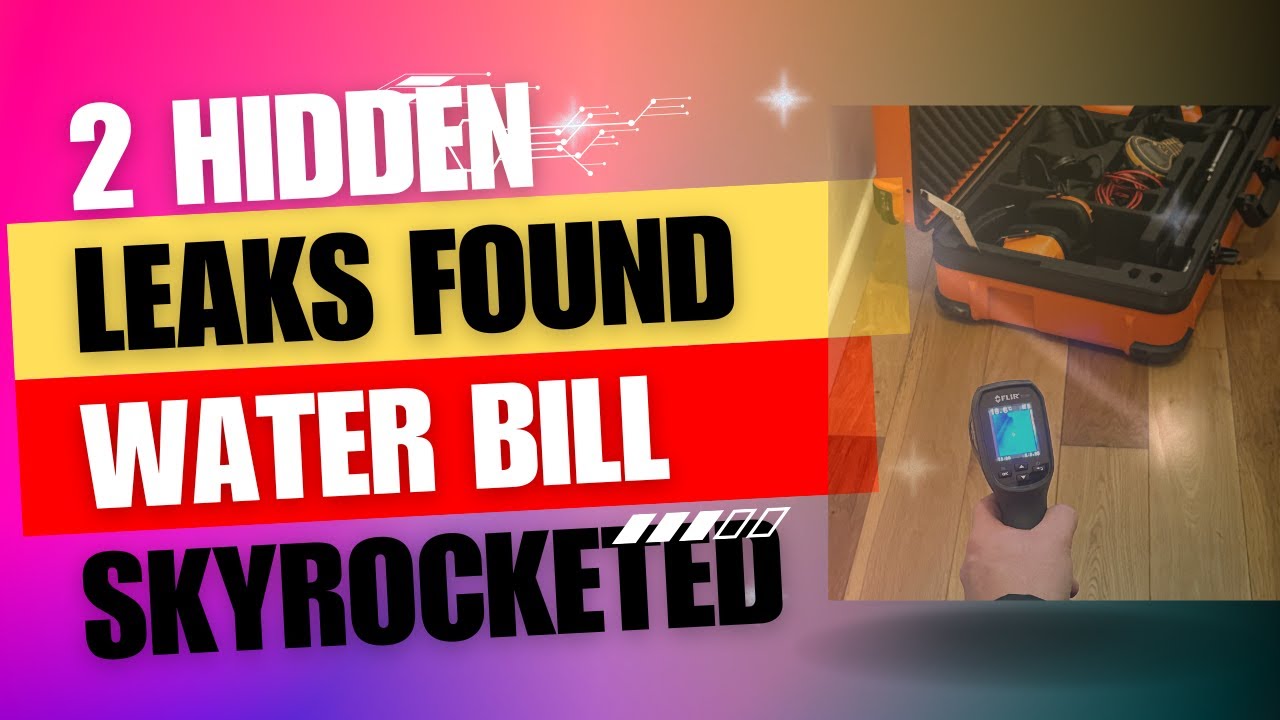
How we found hidden water leaks without damaging your home

Professional Leak Detection Equipment Used by MML Plumbing
MML Plumbing Ltd is a family-run plumbing and leak detection company based in Barnet, North London.
Our engineers use specialist diagnostic equipment to investigate concealed plumbing leaks, heating pipework, underground water supplies and water escaping from bathroom installations.
The choice of equipment depends on the property, the reported symptoms and the results obtained during the investigation.
For more information about our investigation process, visit our professional leak detection service page.
We also provide leak detection across North London, including Barnet, Finchley, Muswell Hill, Highgate, Hampstead and surrounding areas.
We don’t guess. We prove. Then we fix.
Buying a Home? Know What Plumbing Repairs You May Face
Get a clearer picture of the property’s plumbing before you commit. MML Plumbing can assess accessible systems, explain any concerns we find, and help you plan your next steps. Request a pre-purchase plumbing survey quote.
FAQ
Question not answered? Ask A Question by email
Can a Thermal Imaging Camera See Water Leaking Behind a Wall?
A thermal imaging camera cannot see through a wall or directly identify water. It detects infrared radiation from the visible surface and displays apparent temperature differences. These patterns may indicate concealed hot-water pipework or moisture-related cooling, but additional investigation is necessary to establish the cause.
What Is the Most Accurate Water Leak Detection Equipment?
There is no single instrument that is most accurate in every situation. Acoustic equipment may be effective for a noisy pressurised leak, while hydrogen tracer gas may be more useful when the leak produces little detectable sound. Thermal imaging and moisture meters provide supporting evidence but do not independently prove the location of a leaking pipe. Accuracy depends on selecting the appropriate method and interpreting the results correctly.
How Does Hydrogen Tracer Gas Equipment Find Underground Leaks?
A suitable tracer gas mixture is introduced into an isolated pipe system under controlled conditions. A hydrogen-sensitive detector is then used to investigate where escaping gas becomes detectable. The findings help narrow down the suspected area, although gas can migrate through surrounding materials before reaching the surface.
Can a Moisture Meter Tell Where a Pipe Is Leaking?
A moisture meter identifies moisture-related changes in the tested material. It cannot determine whether the moisture originated from a leaking pipe, condensation, rainwater penetration or another source. Engineers use moisture mapping to understand the affected area and combine the findings with other diagnostic methods.
What Equipment Is Used to Detect Leaks Beneath Concrete Floors?
Depending on the pipe system and conditions, engineers may use acoustic listening equipment, thermal imaging, pressure testing and hydrogen tracer gas detection. Pipe-location equipment may also help establish the route of concealed services. The appropriate combination depends on whether the suspected leak involves heating, hot water or a cold-water supply.
Can I Buy Professional Leak Detection Equipment and Find a Leak Myself?
Some basic tools, including moisture meters and water-monitoring devices, are available to homeowners. However, interpreting readings from professional acoustic, thermal imaging, and tracer gas equipment requires technical knowledge and experience. Incorrect interpretation can lead to unnecessary damage or repairs in the wrong location. Specialist pressure and tracer gas testing should be carried out by competent professionals.


