
A central heating system airlock forms when trapped air collects in pipework or radiators and restricts hot-water circulation. Typical signs include cold spots at the top of a radiator, gurgling noises and uneven heating. Bleeding an affected radiator can release trapped air, but it will not resolve every circulation problem. Recurring air or radiators that remain cold need further investigation.
Similar symptoms can result from restricted valves, poor balancing or sludge, so identifying the cause matters before choosing a repair. This guide explains the differences, the checks you can safely make and when to seek professional help. MML Plumbing investigates radiator, heating-pipework and circulation problems across North London to establish what needs fixing.

How can you tell if your central heating system has an airlock?
An airlock can reduce or stop water circulation through part of a central heating system. However, cold radiators do not automatically mean trapped air: closed valves, poor balancing, debris and pump problems can produce similar symptoms.
Start by identifying the pattern. Is one radiator affected, several on the same floor, or the whole heating system? Did the problem begin after a radiator was replaced or the system was drained?
Air trapped inside a radiator tends to collect near its top. Air can also gather at high points in heating pipes, where it may restrict the flow supplying other radiators.
| Symptom | Possible explanation | Appropriate next step |
|---|---|---|
| Cold spots at the top of the radiator, with warmth below | Trapped air | Allow the radiator to cool before bleeding |
| Gurgling or bubbling in radiators | Air moving through the water | Check which radiators heat unevenly |
| Radiator warm at the top but persistently cold below | Sludge or restricted flow | Arrange assessment rather than repeatedly bleeding |
| One radiator stays completely cold | Valve, balancing, circulation or air problem | Check its normal temperature setting, then seek help if needed |
| Several radiators stop heating after maintenance | Incomplete filling or venting, or another circulation fault | Contact the engineer who completed the work |
| Pressure repeatedly falls | A pressure-control or water-loss problem | Record the pressure gauge readings and arrange an investigation |
A radiator with trapped air is not necessarily a faulty radiator that needs replacing. The problem may be recoverable once its cause is established.
Do banging sounds mean there is air in the heating?
Gurgling can suggest air moving through the heating system. Banging sounds, tapping and clicking are less specific and can also occur as pipes expand, move against their surroundings or experience changes in flow.
Note when the noise happens. Sounds during heating warm-up may have a different cause from a bang when the water supply to a tap or appliance stops. Noise alone is not enough to diagnose an air lock.
Why does trapped air build up in central heating systems?
Air can enter when the system is drained, repaired or refilled. If filling and venting are incomplete, pockets may remain in radiators or high sections of pipework.
Fresh filling water also contains dissolved air. As the water heats up, some of that air can form bubbles. These can collect where the system does not carry them effectively to an appropriate vent.
The system arrangement matters:
- Sealed central heating systems have a pressurised water circuit and an expansion vessel.
- Open-vented systems normally use a feed-and-expansion cistern and an open vent.
A qualified heating engineer needs to identify the arrangement before deciding how to investigate recurring air or restore circulation.

Does air always collect at the highest point?
Air tends to rise within water, so high points and the top of radiators are common collection points. However, pipe layout, flow and local restrictions also affect where air becomes trapped.
A top-floor radiator may show symptoms, but the highest radiator is not automatically the source of the problem. Downstairs radiators can also contain air.
Can a heating system create excess water vapour?
Ordinary radiator airlocks should not be explained as the system needing to “create excess water vapour”. Air released from water and water vapour produced by evaporation or boiling are different things.
For a homeowner, the useful distinction is between trapped air that can be released through a radiator bleed valve and a persistent circulation or overheating problem that needs professional advice. Repeatedly bleeding radiators is not a universal fix.
What should you check before bleeding radiators?
Before releasing air, check that the heating is calling for heat and the affected radiator’s normal temperature control is not turned off. Compare its temperature pattern with other radiators without touching surfaces that may be dangerously hot.
Look for visible moisture around accessible valves and pipe joints. If you have a sealed heating system, note the pressure gauge reading and compare it with the manufacturer’s operating instructions.
These observations help distinguish radiators failing to heat because of trapped air from other causes. Do not adjust balancing valves, pump settings or unfamiliar controls to try to force water through the system.
If several radiators are affected or you are unsure which valve is which, contact a professional plumber in London before proceeding.
How can trapped air in a heating system be cleared?
Clearing trapped air from a central heating system involves a few straightforward steps:
- Turn off the System: Before you begin, ensure the heating system is turned off to avoid accidents or spills.
- Locate Bleed Valves: Find the bleed valves on your radiators. These small valves are usually situated at the top of the radiator.
- Prepare a Container: Place a container or cloth beneath the TRV to catch any water that may come out.
- Open the Valve: Using a radiator key or a flat-head screwdriver, gently turn the TRV anticlockwise to open it. You’ll hear a hissing sound as the trapped air escapes.
- Close the Valve: As soon as the water starts to flow consistently from the TRV, close it clockwise. Be cautious, as the water may be hot.
- Repeat the Process: Go through this process for all radiators in your system, starting with the lowest one and moving upwards.
How do you release trapped air with a radiator key?
Use the radiator’s bleed valve to release air. This is usually near the top of the radiator and is separate from the valves that control water entering and leaving it.
You will need:
- A suitable radiator bleed key.
- A dry cloth to protect the surrounding area.
- A small container to catch drips.
Some vents use a different tool. Follow the radiator manufacturer’s instructions rather than forcing an unsuitable bleed key into the screw.
1. Switch off the heating and let the radiator cool
Wait until the radiator is cool before opening the vent. A fixed waiting period does not suit every heating system, because water temperatures and cooling times vary.
Do not bleed a hot radiator. Water coming from the vent can cause burns.
2. Locate the bleed valve
Find the small bleed screw near the top of the radiator. Do not confuse it with the thermostatic radiator valve, which controls the radiator’s temperature.
If the vent is damaged, painted shut or difficult to identify, stop and seek professional advice. Basic plumbing knowledge does not make it safe to loosen unfamiliar fittings.
3. Protect the wall and floor
Hold the dry cloth beneath the vent and position the container to catch a small amount of water. Keep your face and hands away from the outlet.
4. Open the bleed screw slightly
Using the radiator key, turn the screw slowly anticlockwise just enough to release air. A hissing sound usually indicates air escaping.
Stop turning once the air begins to escape. Do not remove the bleed screw or continue opening it to make the process faster.
5. Close the vent when water appears
When the hissing stops and water flows from the vent, gently close the bleed screw with the correct key. Do not use a wrench to overtighten it.
Wipe the area and check that the valve has sealed.
6. Check before moving to the next radiator
If another radiator has similar symptoms, repeat the process while the heating remains off and the radiators are cool. Before moving to the next radiator, check that the previous radiator’s bleed valve is dry and closed.
Do not assume every radiator needs bleeding. Follow any system-specific sequence in the manufacturer’s instructions rather than treating “downstairs radiators first” as a universal rule.
7. Check pressure and heating performance
For a sealed system, check the pressure gauge after bleeding. Any permitted user top-up should follow the manufacturer’s instructions.
Restart the heating only when the vents are closed and the system is ready to operate. Check whether the affected radiator heats more evenly and whether the other radiators are working correctly.

What if water comes out but the radiator stays cold?
Water appearing immediately at the bleed valve suggests there is no substantial air pocket at that vent at that moment. Draining more water is unlikely to fix a different flow problem and may lower the system pressure.
Close the valve. A radiator that remains cold may have a restricted or closed valve, inadequate circulation, poor balancing or debris inside it.
The temperature pattern helps guide the next investigation. For example, persistent cold spots towards the bottom need a different assessment from air trapped at the top.
What if neither air nor water comes out?
Do not keep unscrewing the vent. The radiator may be isolated, the vent may be blocked, or the system may have a filling or pressure problem.
A professional plumber can establish why water is not reaching the vent without unnecessary draining or damage.
Why do radiators keep filling with air?
Repeated air accumulation can indicate that the original cause has not been resolved. Releasing the air may restore heat temporarily while leaving the underlying filling, venting, circulation or water-loss problem in place.
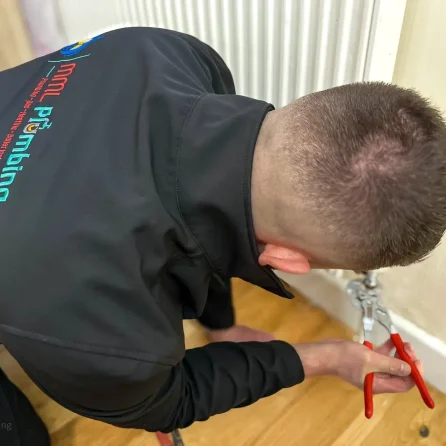
Tell the engineer whether the same radiator is repeatedly affected, whether the problem started after work and whether the pressure changes between checks. These details are more useful than simply describing the whole system as airlocked. It is also important to understand whether trapped air can make it seem like your boiler is losing pressure.
If bleeding only gives a short-lived improvement, ask MML Plumbing to investigate why the problem returns.
Could a hidden heating leak be involved?
A concealed leak is one possibility when recurring symptoms accompany evidence of water loss, such as falling pressure, visible moisture or unexplained damp. Trapped air alone does not prove a leak.
Where the findings justify it, professional leak detection can help narrow down the source before unnecessary access through a wall or floor. The investigation should follow the evidence rather than assuming every circulation problem needs specialist leak testing.
Could sludge or a pump problem be mistaken for an airlock?
Yes. Dirt build-up, corrosion debris, restricted valves and pump problems can all reduce water flow and leave radiators cold.
A circulation pump moves heating water around the circuit. Poor circulation does not by itself show whether the pump, trapped air or another restriction is responsible. Do not open the pump or alter its settings as a general DIY airlock remedy.
Will a power flush fix trapped air?
A power flush is a cleaning process used for suitable systems where contamination is a confirmed concern. It should not be prescribed automatically because one radiator contains air.
An engineer should first establish whether the problem is trapped air, debris, a valve fault or another restriction. A flush cannot repair every circulation problem, and cleaning suitability depends on the condition of the system.

Need help with trapped air or cold radiators?
MML Plumbing Ltd is a family-run plumbing and specialist leak-detection company serving North London and surrounding areas.
When you contact us, tell us:
- Which radiators are affected and where they feel cold.
- Whether the problem began after draining, repairs or radiator replacement.
- Whether bleeding releases air and how long any improvement lasts.
- Whether pressure changes or visible water leaks are present.
Request a quote for investigation of persistent radiator or heating-pipework problems. The cost depends on access, the checks required, and the repair identified.

Radiators Still Cold After Bleeding?
Stop guessing why your heating isn’t working properly. MML Plumbing investigates trapped air, poor circulation and heating pipework problems to identify the cause and recommend the right repair. Request a quote today.
FAQ
Question not answered? Ask A Question by email
Clearing airlocks from central heating and hot water systems may require a bit of patience, but the improved performance and comfort they bring to your home are well worth the effort. If you find that the problem persists or if you’re uncomfortable performing these tasks yourself, it’s recommended to seek assistance from a professional plumber.
Will an airlock clear itself if I leave the heating running?
Small bubbles may reach a functioning automatic air vent, but a persistent air pocket can remain. Do not leave poorly performing heating running indefinitely in the hope that it will clear. Arrange advice if the symptoms persist.
Can trapped air reduce the heat produced by a radiator?
Trapped air can reduce the radiator’s effective heat output by preventing part of it from filling properly with hot water. This can make a room slower to warm up, although the effect on energy bills depends on the controls and how the heating is used.
Do I need to bleed downstairs radiators as well as top-floor radiators?
Only when the symptoms or system instructions indicate a need. Air tends to rise, but downstairs radiators can also contain trapped air. The floor a radiator is on does not establish whether it needs bleeding.
Can a magnetic filter prevent airlocks?
A magnetic filter captures magnetic debris in heating water; it does not normally remove trapped air. Air vents and air separators perform a different function, although some products combine features.
Does a radiator need replacing if it repeatedly collects air?
Not necessarily. Recurring air may reflect a wider system problem rather than a faulty radiator. Establish the cause before paying for a replacement.
Can MML repair after finding the cause?
MML can carry out appropriate wet-side plumbing and heating repairs once the cause is established. The work may involve radiators, heating pipework, valves or water leaks, depending on the findings.


