


No guessing. No damage. Just clear answers.
The Problem: Boiler Pressure Kept Dropping
The property had a relatively large heating system with more than ten radiators connected to a modern system boiler located in the plant room.
The customer had been repeatedly topping up the system because the pressure would not remain stable.
There was no obvious water escape that could immediately explain the pressure loss.
Before assuming that the floor needed to be opened, we carried out a systematic leak detection investigation to establish whether the pressure loss was coming from concealed heating pipework and, if so, to narrow down its location.

Initial Heating System Investigation
The heating system was briefly operated so that its behaviour could be observed under normal conditions.
A noticeable pressure drop was recorded, confirming that the reported pressure-loss problem was present.
Because the flat is on the ground floor, we also considered the heating installation above. The upper-floor radiators were visually inspected, but there was no corresponding water damage to the ceilings below that would suggest a significant leak from those areas.
The investigation therefore concentrated on the ground-floor heating circuit.
How we found hidden water leaks without damaging your home





Damp Found in the Living Room – But It Was Not the Heating Leak
During moisture testing in the living room, elevated readings were found close to the floor.
Some sections of the timber flooring showed deterioration and early signs of rot.
This initially appeared significant. However, further investigation did not connect this dampness with the heating-system pressure loss.
The moisture could potentially have been associated with another source, such as nearby waste pipework or separate water ingress, and further investigation could be required if the dampness continues.
This was an important part of the investigation because finding moisture does not automatically mean you have found the heating leak.
The evidence still had to match the behaviour of the pressurised heating system.
Tracing the Heating Pipes Beneath the Floors
Sections of the radiator pipework in the living room ran within the skirting, while other heating pipes disappeared beneath the floor.
One accessible section showed surface corrosion or discolouration, but inspection confirmed that it was not actively leaking and did not explain the pressure loss.
We continued tracing the system towards the kitchen and plant room.
The kitchen presented a greater challenge because sections of the heating pipework were concealed beneath a tiled concrete floor.
Opening the floor at this stage would have involved unnecessary destructive access without sufficient evidence of the leak location.
Thermal Imaging Identified Abnormalities Beneath the Kitchen Floor
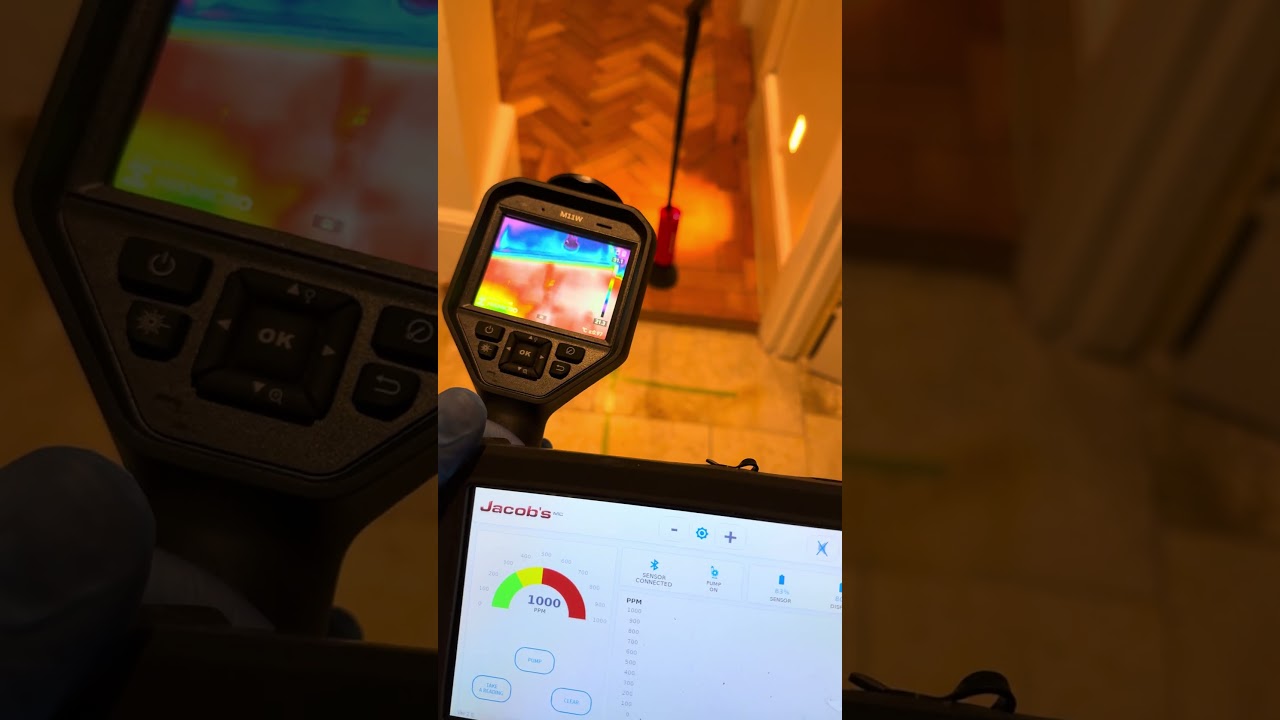
Thermal imaging was used across the tiled kitchen floor and around the route towards the plant room.
Abnormal temperature distribution was identified beneath sections of the floor.
The thermal pattern suggested that further investigation of this area was justified, but thermal imaging alone could not confirm the exact position of the leaking pipe.
We therefore progressed to tracer-gas testing.


Hydrogen Leak Detection Used to Narrow Down the Leak
The heating system was drained and prepared for hydrogen tracer gas leak detection.
Tracer gas was introduced into the heating circuit, and the ground-floor surfaces were systematically scanned using a sensitive hydrogen detector.
Hydrogen traces were initially detected spreading through the kitchen area.
However, the investigation did not stop at the first positive reading.
We continued testing to establish where the strongest concentration was emerging.
Highest Hydrogen Reading Found Near the Plant Room
The strongest hydrogen response was identified directly in front of the plant room, close to the bathroom entrance.
A second significant response was found beneath the washing machine nearby.
At the strongest location, the detector recorded approximately 1,000 ppm.
Further scanning was then carried out across the living room and other accessible areas.
No corresponding hydrogen rise associated with the heating circuit was detected elsewhere during the investigation.
Based on the distribution of the tracer gas and the concentration of the readings, the evidence narrowed the suspected heating leak to the concealed floor area around the plant room, bathroom entrance and washing-machine location.
Why the Exact Leak Location Matters Before Opening the Floor
The suspected pipework is beneath a combination of timber flooring and concrete.
Without leak detection, locating the fault could have involved lifting flooring and breaking concrete across a much larger area.
Instead, the investigation allowed us to identify a significantly smaller area for controlled access.
This is one of the main purposes of professional hydrogen leak detection: not simply proving that a heating system is leaking, but gathering evidence that helps determine where access should be made.
Repair Access Required
Repairing the heating pipe will require controlled access to the identified area.
The washing machine will first need to be moved. Its existing timber support has already suffered substantial water damage and deterioration and will require replacement.
Sections of the timber flooring will then need to be removed.
Because the heating pipe is expected to run beneath the concrete base, part of the concrete will also need to be carefully opened to expose the pipework.
Depending on the pipe route and what is discovered after access, approximately 1–1.5 metres of floor opening may be required to provide sufficient working space and allow the surrounding pipework to be inspected.
The exact extent of the opening can only be confirmed once the concealed pipe is exposed.

Testing the Heating System After Repair
Locating the leak is only part of the process.
Once the defective pipework is exposed and repaired, the heating system should be tested again before the floor is reinstated.
The repair process includes:
- exposing the affected heating pipe
- repairing the defective section
- inspecting nearby accessible pipework
- retesting the repaired section
- refilling the heating system
- pressure testing
- checking system operation
- balancing the heating system where required
- verifying that the pressure remains stable
Only after successful testing should the floor structure be reinstated.
Because concrete requires curing and drying time, final reinstatement may need to be completed in stages.
The Result of the Leak Detection Investigation
This investigation successfully narrowed a difficult boiler pressure-loss problem to a concealed section of heating pipework beneath the ground floor.
The key findings were:
- The heating system was confirmed to be losing pressure
- no obvious upper-floor leak was identified
- living-room dampness was investigated but was not linked to the heating pressure loss
- thermal imaging highlighted an area requiring further investigation
- Hydrogen tracer gas was detected beneath the kitchen area
- The strongest reading, approximately 1,000 ppm, was found near the plant room and bathroom entrance
- A secondary strong reading was found beneath the washing machine
- No comparable tracer-gas response was detected elsewhere during the investigation
The evidence therefore provided a targeted area for controlled access rather than relying on guesswork or unnecessarily opening large sections of flooring.


Professional Leak Detection Before Destructive Access
This NW3 case demonstrates why a boiler that keeps losing pressure should be properly investigated before floors are opened.
Moisture readings, thermal anomalies or corroded pipework can provide useful clues, but each finding needs to be tested against the behaviour of the heating system.
For difficult concealed leaks, we may combine several methods as part of our Leak Detection in London service rather than relying on one piece of equipment.
For properties across this part of the capital, our Leak Detection in North London investigations can include thermal imaging, moisture testing, heating-system pressure testing and tracer-gas testing depending on the symptoms and construction of the property.
Where conventional investigation cannot sufficiently narrow down concealed heating pipework, Hydrogen Leak Detection in London can provide additional evidence before destructive access is considered.
You can also view our MML Plumbing Case Studies to see other real investigations involving boiler pressure loss, concealed pipework and difficult-to-locate water leaks across London.
Boiler Losing Pressure With No Visible Leak?
If your boiler keeps losing pressure and you cannot see where the water is escaping, repeatedly topping up the system does not identify the underlying cause.
MML Plumbing investigates concealed central heating leaks across London using evidence-led leak detection methods designed to narrow down the source before unnecessary floors, walls or ceilings are opened.
Contact MML Plumbing to arrange a specialist boiler pressure-loss and hidden heating leak investigation.


